Artificial intelligence (AI) for marketing purposes encompasses the use of AI strategies and tools to enhance the effectiveness of advertising campaigns and tactics. This calls for machine learning algorithms, natural language processing, statistical data analysis, and additional AI tools to automate and optimize promotional activities, gain a deeper understanding of customers, and improve overall marketing performance.
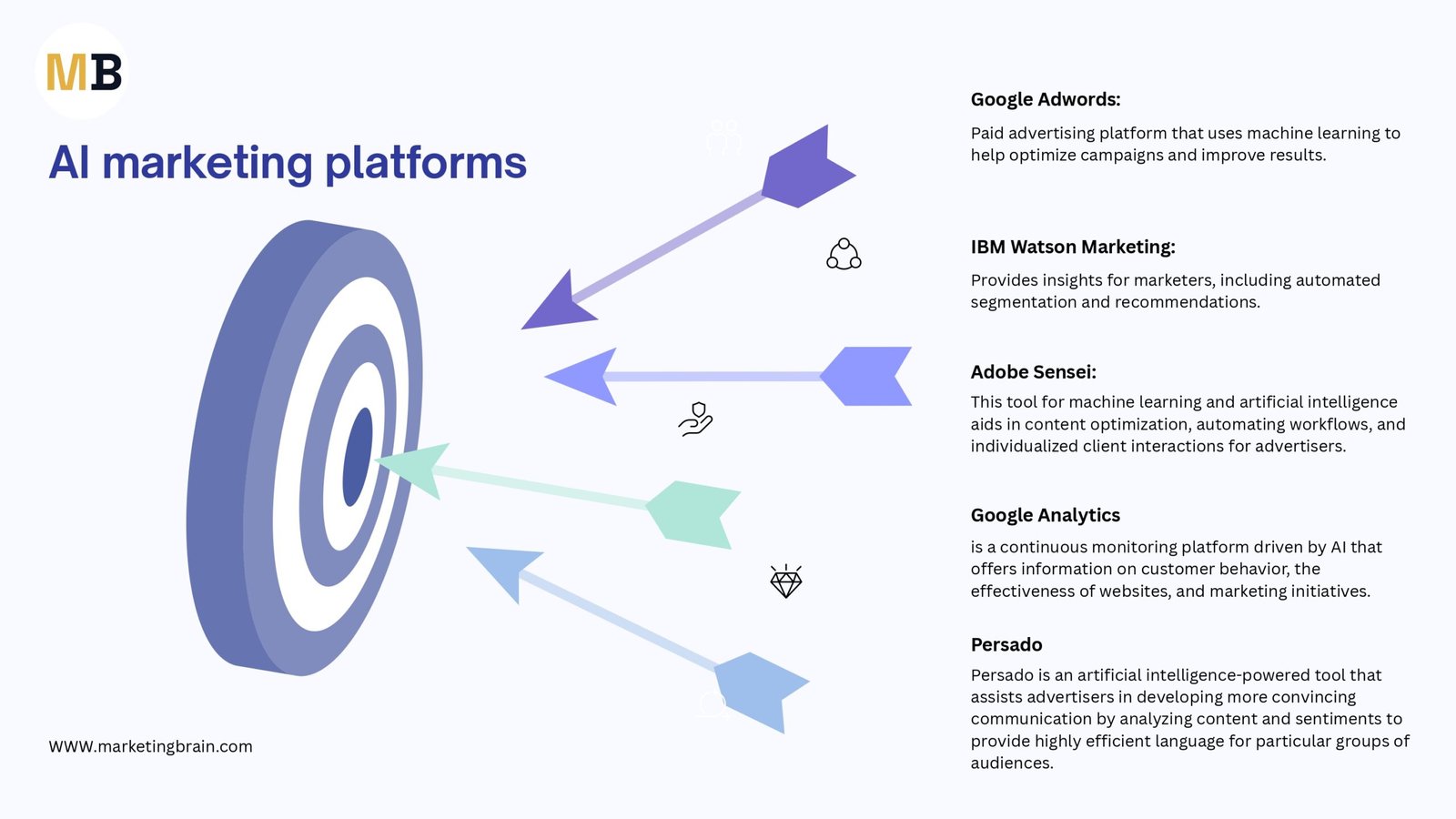
AI Marketing Platforms
Several AI-powered platforms help marketers automate, analyze, and optimize their campaigns more effectively.
- Google Ads: A paid advertising platform that uses machine learning to help optimize campaigns and improve results.
- IBM Watson Marketing: Provides insights for marketers, including automated segmentation and recommendations.
- Adobe Sensei: A machine learning and AI tool that aids in content optimization, automating workflows, and personalized client interactions for advertisers.
- Google Analytics: A continuous AI-driven monitoring platform offering insights on customer behavior, website effectiveness, and marketing initiatives.
- Optimizely: An AI-powered experimentation tool used to test and improve online stores, mobile apps, and other digital products.
- Persado: An AI tool that helps advertisers craft more persuasive messaging by analyzing content and sentiment to generate highly effective language for specific audiences.
These platforms not only optimize advertising campaigns but also provide insights that drive customer satisfaction and business success.
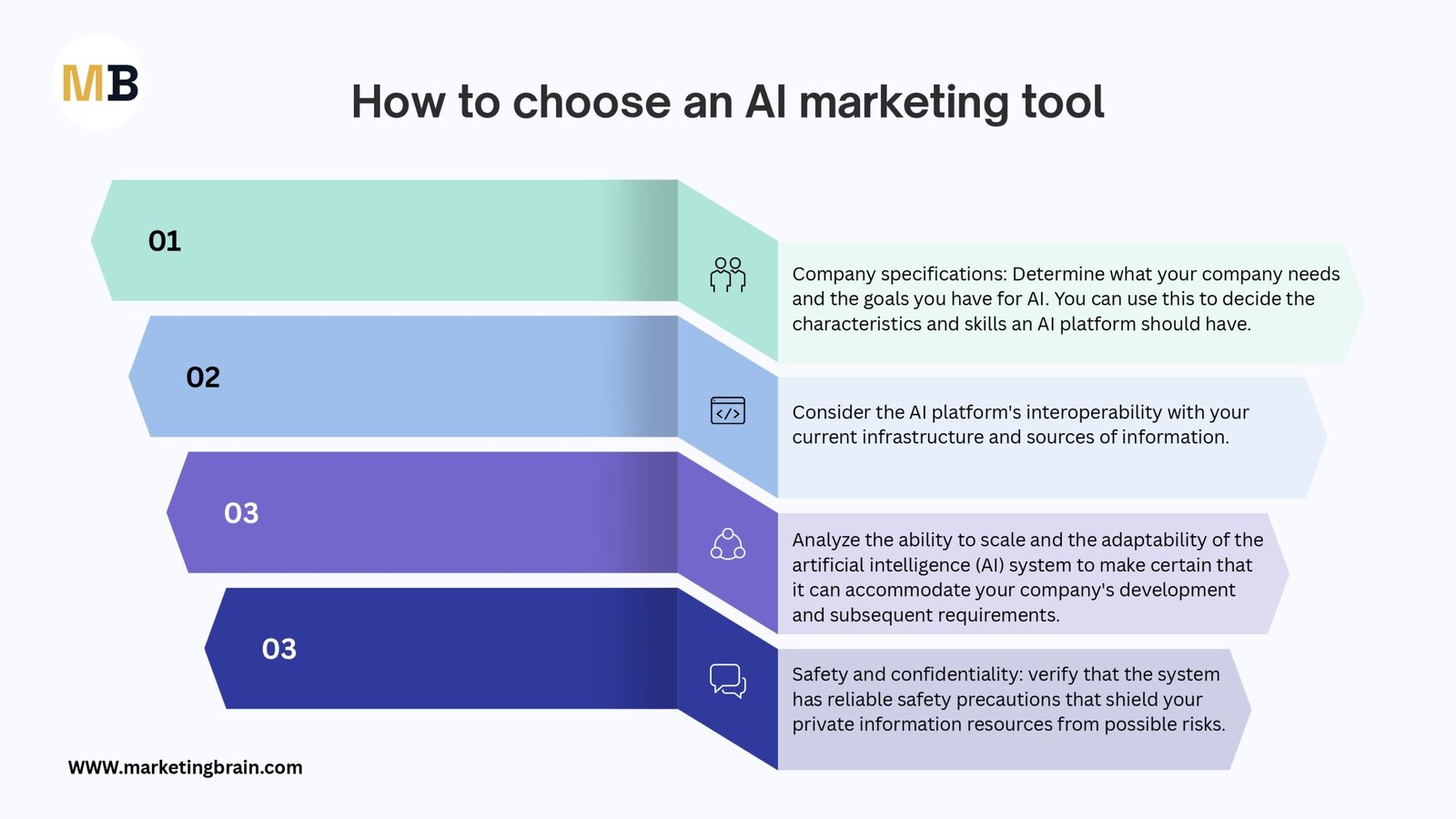
How to Choose an AI Marketing Tool
The nature of your task, your organization’s budget and expertise, and the system’s features all play a role in choosing the right AI platform. Keep the following points in mind:
- Company specifications: Determine what your company needs and your goals for AI.
- Compatibility: Consider the AI platform’s interoperability with your existing infrastructure and data sources.
- Scalability: Make sure the system can accommodate your company’s growth and future requirements.
- Safety and confidentiality: Verify that the system has reliable security measures to protect your data.
- Efficiency and reliability: Examine the system’s speed, availability, and accuracy.
- Support and services: Look for providers offering strong support, maintenance, and advisory services.
Benefits of Artificial Intelligence in Marketing
AI provides several advantages to marketers, transforming how marketing efforts are carried out and generating real monetary benefits.
With AI, marketers can offer each customer a highly personalized experience at scale by analyzing huge volumes of customer data to find trends, choices, and behaviors. AI systems can also categorize audiences effectively, allowing marketers to create more focused and relevant campaigns. AI provides data-driven predictive analytics that helps marketers make informed decisions and optimize tactics.
AI-driven automation streamlines repetitive marketing tasks like email marketing, social media planning, ad campaign management, and customer service, freeing up professionals to focus on higher-value work. AI-powered chatbots and virtual assistants offer real-time support and improve the overall customer experience. AI also enables marketers to analyze large, complex datasets instantly, spot trends, and generate useful reports for performance monitoring.
Real-time analysis of customer behavior allows marketers to make quick adjustments, react to shifting market dynamics, and increase ROI — all while lowering operational costs and manual labor.
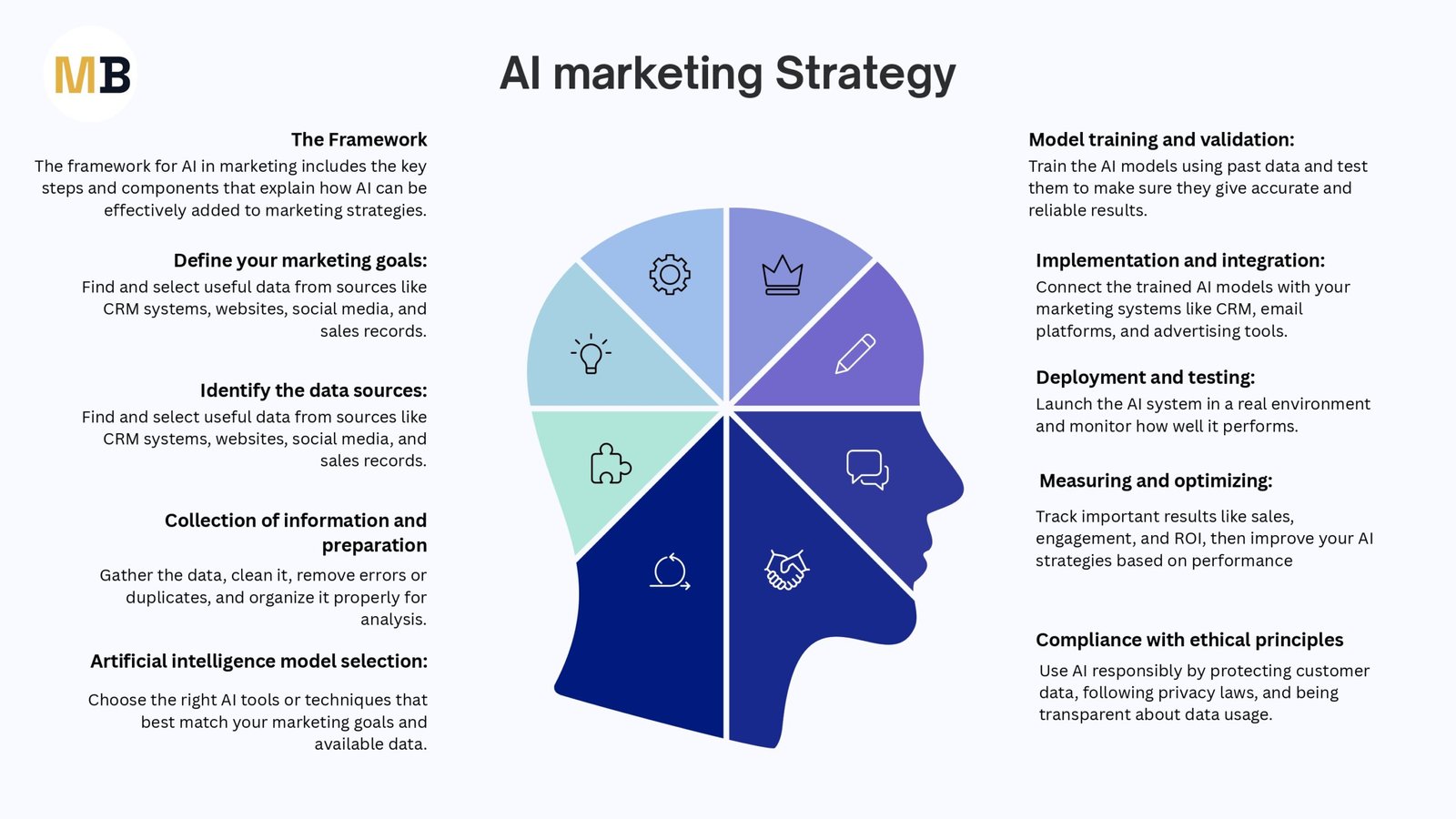
AI Marketing Strategy: The Framework
The framework for AI in marketing consists of several essential steps that define how AI can be successfully incorporated into marketing plans.
Define Your Marketing Goals
State your marketing objectives clearly — whether it’s strengthening personalization, boosting sales conversions, raising customer engagement, or optimizing marketing initiatives.
Identify the Data Sources
Choose data sources relevant to your marketing objectives, such as CRM systems, website analytics, social media platforms, and transactional data. Examine the data’s reliability and accessibility.
Data Collection and Preparation
Gather and compile relevant data from various sources. Clean and preprocess it by removing duplicates, handling missing values, and standardizing formats for AI analysis.
AI Model Selection
Determine which AI methods and algorithms match your marketing goals and data, such as NLP, computer vision, recommendation systems, or predictive analytics.
Model Training and Validation
Use collected data to train your AI models. Feed historical or labeled data into the models so they can discover trends and make predictions, then validate outcomes using proper evaluation metrics.
Implementation and Integration
Integrate the trained AI models with your marketing systems and processes, such as your CRM, email marketing platform, and advertising tools.
Deployment and Testing
Implement the AI models in a live environment, monitor their effectiveness, and continually improve them based on outcomes and feedback.
Measuring and Optimizing
Track key indicators like client engagement, sales conversions, click-through rates, and ROI, and use the insights to optimize your AI models and marketing tactics.
Compliance with Ethical Principles
Ensure responsible and ethical use of AI in marketing. Address privacy concerns, follow data protection laws, and maintain transparency regarding data use and personalization.
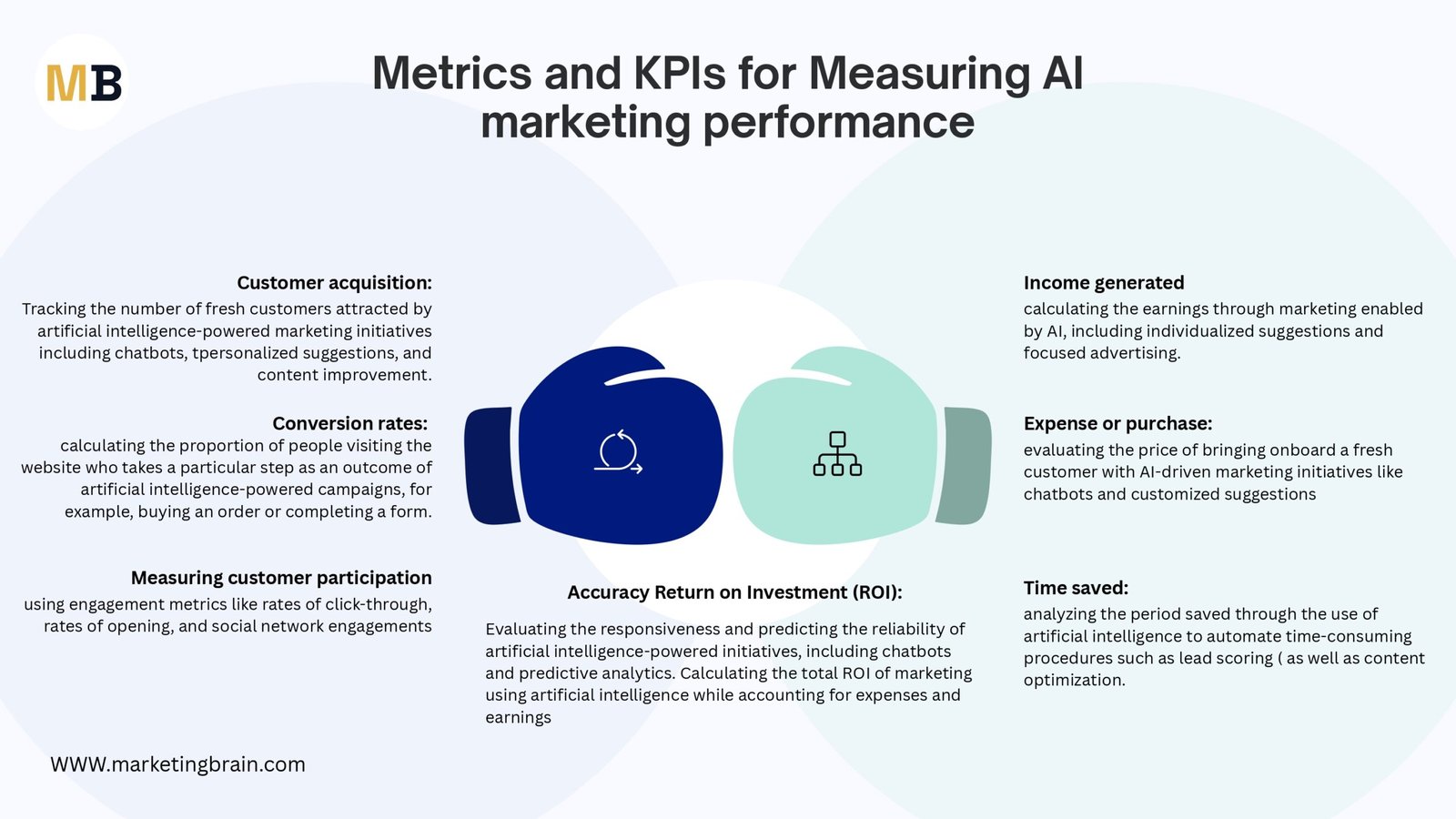
Metrics and KPIs for Measuring AI Marketing Performance
The following indicators help evaluate the effectiveness of AI marketing efforts:
- Customer acquisition: Tracking new customers attracted by AI-powered initiatives like chatbots and personalized suggestions.
- Conversion rates: Measuring the proportion of visitors who complete a desired action as a result of AI-powered campaigns.
- Engagement metrics: Tracking click-through rates, open rates, and social media engagement.
- Revenue generated: Calculating earnings driven by AI-enabled marketing, including personalized suggestions and targeted advertising.
- Cost per acquisition: Evaluating the cost of onboarding a new customer through AI-driven initiatives.
- Time saved: Analyzing time saved by automating tasks like lead scoring and content optimization.
- Accuracy and ROI: Evaluating the reliability of AI-powered predictions and calculating overall marketing ROI.
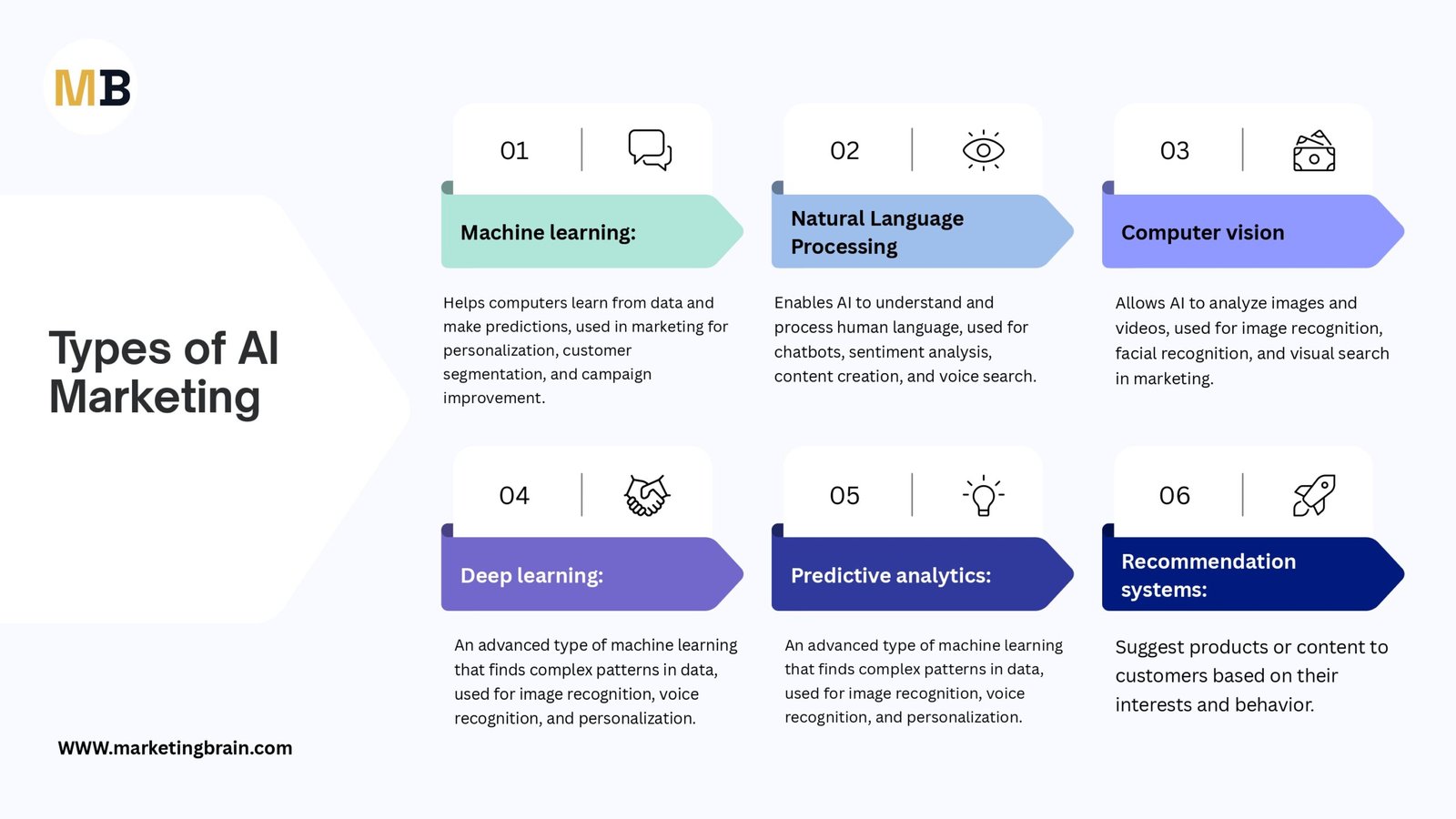
Types of AI Marketing
- Machine Learning: Allows systems to learn from data and make predictions without explicit programming — used for campaign optimization, personalized suggestions, and customer segmentation.
- Natural Language Processing (NLP): Helps AI understand and process text, audio, and sentiment — used in chatbots, sentiment analysis, content creation, and voice search optimization.
- Computer Vision: Used for image recognition, object detection, facial recognition, and visual search in marketing.
- Deep Learning: A branch of machine learning using neural networks for image and audio recognition, personalization, and language understanding.
- Predictive Analytics: Uses statistical modeling and past data to forecast customer behavior, identify leads, and improve pricing strategies.
- Recommendation Systems: Use AI algorithms to make personalized product, content, and offer suggestions.
- Chatbots and Virtual Assistants: AI-powered conversational agents used for lead generation, customer service, and personalized messaging.
- Robotic Process Automation (RPA): Automates rule-based tasks like data entry, report preparation, and campaign management.
Examples of AI in Marketing
Numerous businesses across different industries are already using AI for marketing.
Amazon heavily relies on AI for personalized recommendations, analyzing user behavior, past purchases, and browsing habits. Netflix uses AI to offer viewers individualized content suggestions based on viewing trends and preferences. Spotify uses AI to generate custom playlists and music suggestions by analyzing listening history.
Coca-Cola uses AI to identify target groups, create personalized content, and improve customer experience. Starbucks uses AI in its mobile app for personalized drink recommendations and to manage inventory and store layout. Sephora uses AI for personalized suggestions and its Virtual Artist feature, combining AR and AI for virtual product try-ons.
HubSpot provides AI-powered marketing automation tools for audience segmentation and content personalization. Nike uses AI to analyze customer data and social trends for personalized ads and product recommendations. Walmart uses AI for personalized recommendations, price optimization, and supply chain management.
Adidas personalizes its email marketing using AI through its “All Day” app, analyzing user data like social activity, location, and fitness tasks. Under Armour uses AI in its “UA Record” app to personalize training plans based on exercise habits, diet, and sleep patterns.
Challenges to AI Implementation
Though AI offers numerous advantages for marketing, businesses face several implementation challenges:
- Data quality: AI requires reliable, relevant, and high-quality data to function properly.
- Technical expertise: Implementing AI requires statisticians, intelligence engineers, and developers, which may require investment in training or hiring.
- Integration with current systems: Adding AI to existing marketing platforms can be difficult and time-consuming.
- Cost: Implementing AI can be costly, from hiring experts to investing in software and devices.
- Moral considerations: AI raises questions about bias, honesty, data security, and confidentiality.
- Limited applications: AI isn’t a universally applicable solution and must be carefully evaluated for each use case.
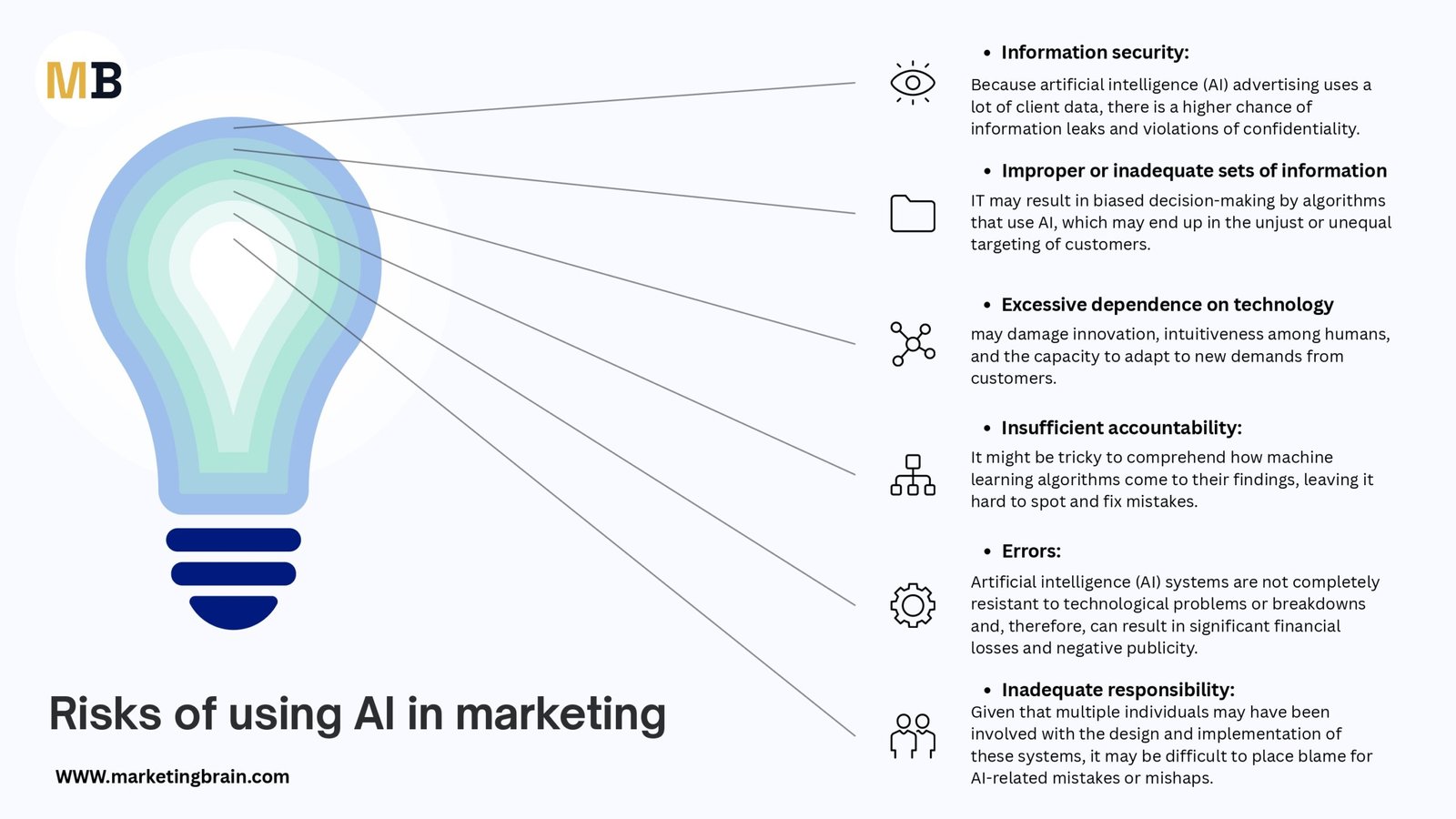
Risks of Using AI in Marketing
- Data security: AI marketing uses large volumes of customer data, increasing the risk of data leaks and privacy violations.
- Biased decision-making: Improper or inadequate data sets may cause AI algorithms to produce biased or unfair targeting.
- Over-reliance on technology: Excessive dependence on AI may damage human intuition, creativity, and adaptability.
- Lack of accountability: It can be difficult to understand how machine learning algorithms reach their conclusions.
- Errors: AI systems aren’t immune to technical failures, which can lead to financial losses and negative publicity.
- Unclear responsibility: Multiple parties may be involved in designing and implementing AI systems, making it harder to assign blame for mistakes.
To manage these risks, businesses must be transparent about how they collect customer data, secure their IT infrastructure, and strike the right balance between automation and human interaction in their marketing strategies.
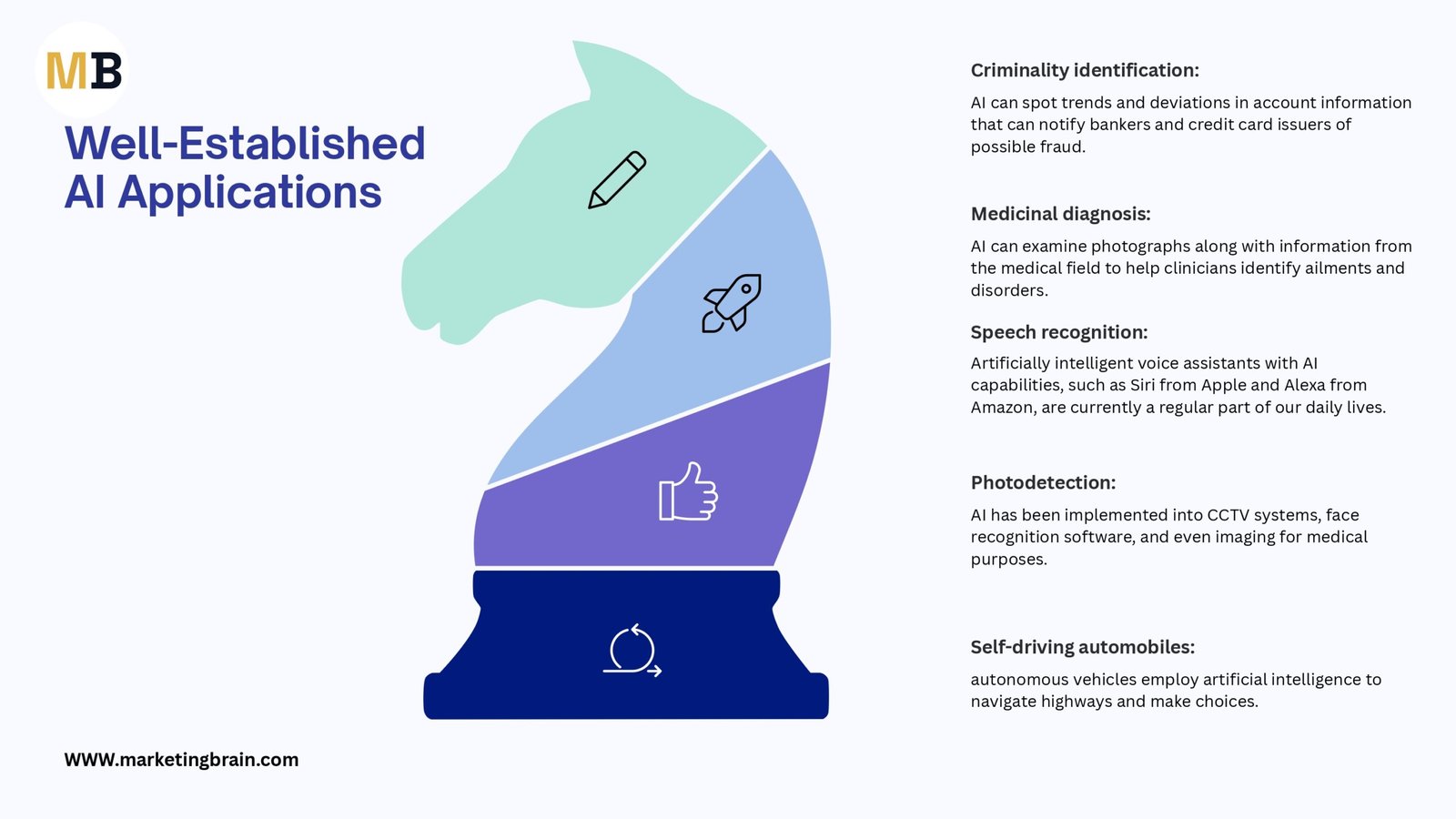
Well-Established AI Applications
- Speech recognition: Voice assistants like Apple’s Siri and Amazon’s Alexa.
- Image detection: AI used in CCTV systems, facial recognition software, and medical imaging.
- Self-driving cars: Autonomous vehicles using AI to navigate and make driving decisions.
- Fraud detection: AI spotting unusual patterns in account data to alert banks and credit card issuers.
- Medical diagnosis: AI analyzing images and medical data to help clinicians identify conditions.
Artificial Intelligence in the Future of Marketing
As technology advances, AI is projected to play an even bigger role in marketing in the years ahead.
Hyper-Personalization
AI will make it possible for marketers to offer every customer an exceptionally personalized experience at scale, processing large volumes of data in real time to tailor offers, recommendations, and content to individual interests.
Voice and Visual Search Optimization
As voice assistants and visual search technologies grow, AI will be essential for optimizing marketing content for voice- and image-based searches.
Smarter Chatbots and Virtual Assistants
Chatbots will become more advanced conversational tools, using NLP and sentiment analysis to better understand and respond to customer inquiries.
AI-Generated Content
Marketers will increasingly use AI to help create blog posts, social media updates, and video scripts, significantly reducing the time needed to produce engaging content.
AR/VR Integration
AI will work alongside virtual reality (VR) and augmented reality (AR) technologies to create realistic, interactive advertising experiences.
Smarter Marketing Automation
Complex marketing processes like lead nurturing, customer journey optimization, and personalized email marketing will become increasingly automated, helping marketers deliver the right message to the right person at the right time across multiple channels.
Conclusion
Artificial intelligence is fundamentally changing how advertisers handle their work. By analyzing vast volumes of data, generating insights, and automating operations, AI is enabling marketers to build more personalized and effective strategies. However, AI is not a permanent solution on its own — advertisers must still apply creative thinking, empathy, and discernment for successful interactions with their target audience. Ultimately, the effective use of AI in marketing depends on finding the right balance between technology and human connection.